Buying Guide · WhatsApp Bot Pricing

WhatsApp Bot for Business: What It Does, What It Costs, and How to Buy the Right One

If your team is still handling every customer enquiry one by one, you’re losing money and time. Here’s what a WhatsApp bot actually does, what it really costs, and how to buy the right one — not just the cheapest one.

Talk to Us on WhatsAppJump to Pricing →
WhatsApp bot for business answering a customer order query

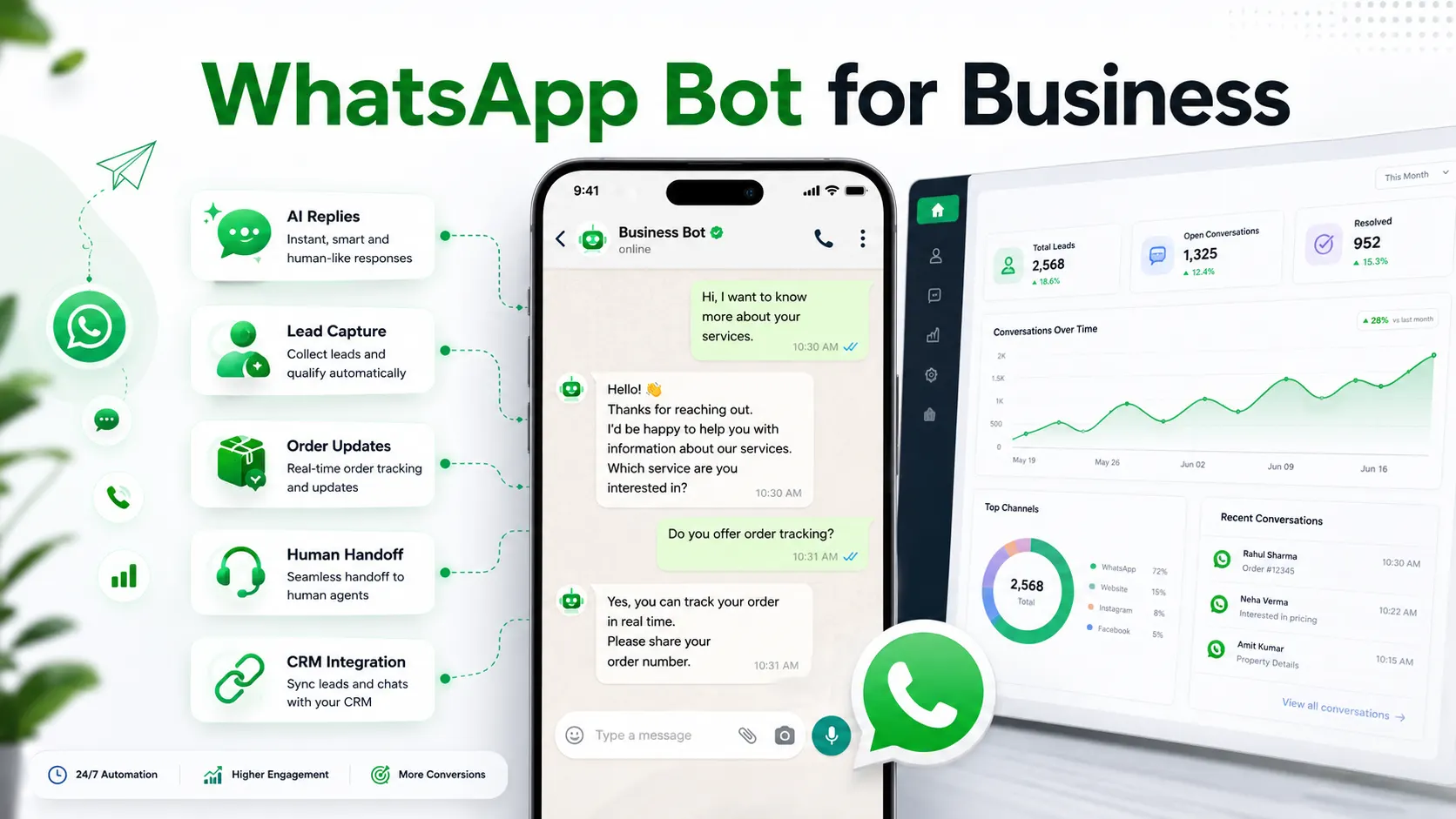
What a WhatsApp Bot for Business Actually Does

Customers can’t be expected to check their email or fill out a contact form several times a day — but an AI WhatsApp chatbot can answer them instantly. At its simplest, a whatsapp bot for business answers common questions in real time — store hours, shipping timelines, return policies — without making anyone wait on hold.

Beyond that, most businesses use one to:

📦

Confirm orders & shipping updates

Sent automatically the moment an order status changes.

📅

Book, reschedule, or cancel appointments

No phone tag, no double bookings.

Verify leads before handoff

Only qualified leads reach your sales team.

💳

Send payment reminders & cart nudges

Recover revenue that would otherwise slip away.

Collect post-purchase feedback

Automatic, without anyone having to remember to ask.

None of this replaces your team. It filters out the predictable, rote-learned questions, leaving room for human interaction where it’s actually needed. For a lot of small and mid-sized businesses, that alone pays for the tool within the first month.

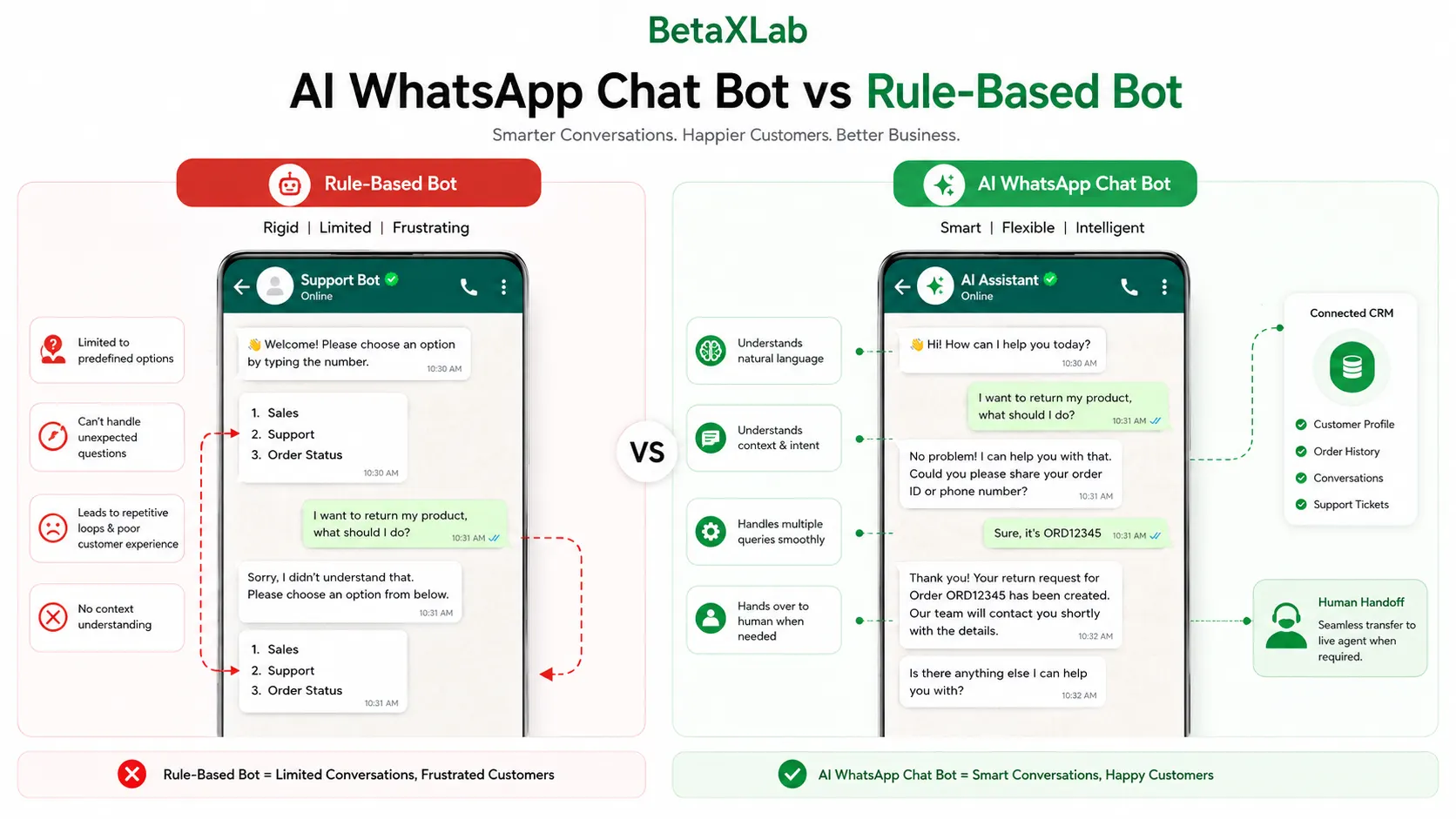
AI WhatsApp Chatbot vs Rule-Based Bot

An AI WhatsApp chatbot can interpret natural language, context, and unstructured text, whereas a rule-based bot works on a specific set of rules that have been predetermined.

AI WhatsApp chatbot vs rule-based WhatsApp bot comparison
FeatureRule-Based WhatsApp BotAI WhatsApp Chat Bot
How it worksPredefined "if/then" logic, menus, and keyword triggers.Understands intent with the help of NLP and LLMs.
Input handlingRequires button taps or exact keyword matching.Corrects typos, slang, rephrasing, voice notes, and mixed languages (Hinglish).
Off-script queriesHits a dead end, loops back to the main menu, or crashes.Pulls an answer from its knowledge base even for a new question.
Context & memoryStateless — every message is treated as an isolated event.Retains conversation history across multiple turns.
Setup & trainingQuick — hours to days with a visual flowchart builder.Days to weeks to train and ingest a knowledge base.
Cost & overheadLow initial cost, low operational maintenance.Higher setup and running cost (token usage / API charges).
Output riskZero hallucination risk — 100% predictable output.Small hallucination risk, mitigated with strict guardrails.
Best forStructured tasks: order tracking, menu routing, appointment booking.Open-ended sales consulting, product recommendations, complex support.

When a rule-based bot is enough

If your enquiries are structured and repetitive — order tracking, menu routing, straightforward appointment booking — a rule-based bot handles them at a lower cost, with zero hallucination risk and setup measured in hours, not weeks.

When you actually need an AI WhatsApp chatbot

Once questions get open-ended — product recommendations, sales consulting, support that needs context from earlier in the conversation — a rule-based menu breaks. That’s the point where an AI WhatsApp chatbot earns its higher setup and running cost.

What Makes the Best WhatsApp Chat Bot

Plenty of tools claim to be the best WhatsApp chat bot on the market, but a handful of things actually separate the good ones from the rest:

  • Genuine language understanding, not just keyword matching
  • Effective transitions to a human agent when limits are reached
  • Support for several languages if your customers aren’t all in one region
  • Integration with tools you already use — CRM, inventory, payment systems
  • Clear analytics so you can see what customers are actually asking
  • Compliance with the official WhatsApp Business Platform rules

Why an official WhatsApp Business partner matters

That last point is more important than people expect. If your bot is connected through an unofficial method, your WhatsApp Business number can be suspended without prior notice. Before you sign up with any provider, confirm they’re an authorized WhatsApp Business API provider — it’s the difference between a bot that grows with you and one that vanishes overnight.

WhatsApp Bot Price: What You Actually Pay

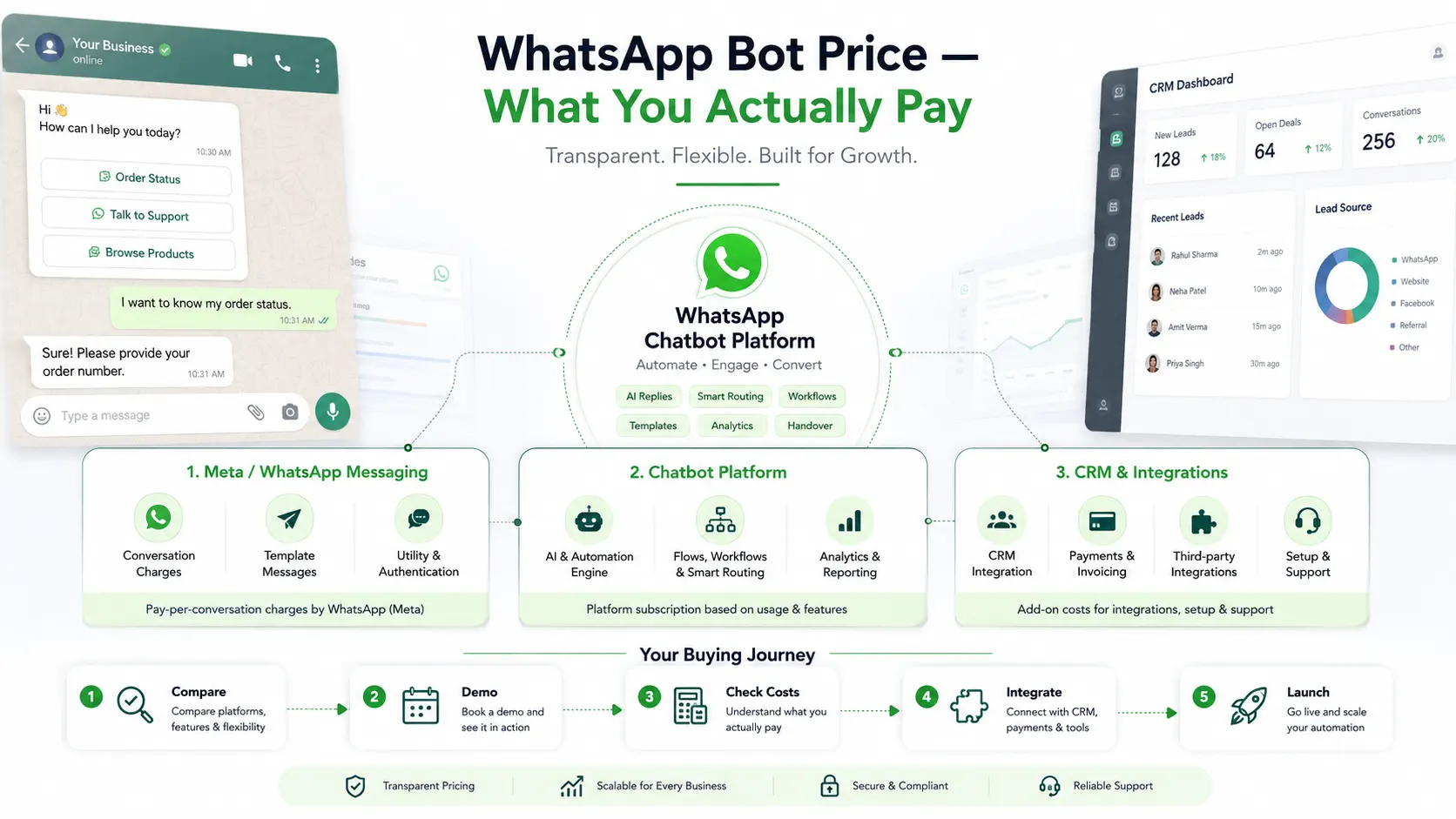
The actual WhatsApp bot price isn’t one number — you’re paying for two services stacked on top of one another: the messaging platform you build the bot on, and Meta’s own per-message charges for the WhatsApp Business Platform.

WhatsApp bot price breakdown showing Meta fees and platform subscription

Meta’s per-message charges

Since mid-2025, WhatsApp charges per message rather than per conversation. The rate depends on what you’re sending — marketing, order updates, or verification codes — and the country your customer is in. Marketing messages cost the most and never get a volume discount; order and verification messages are cheaper and get cheaper still as you scale.

Message typeTypical costNotes
Customer-initiated service chats$0.00Free for the 24-hour service window
Outbound utility / OTP messages$0.001 – $0.003 / messageOrder updates, verification codes
Marketing broadcasts$0.01 – $0.06+ / messageVaries by recipient country, no volume discount

Platform subscription pricing

On top of Meta’s fees, you pay for the software running the bot itself:

Platform tierTypical priceWhat you get
Rule-based builders$15 – $40 / monthEntry-level, menu-driven bots
AI platforms$80 – $300 / monthCustom knowledge base, CRM integration, team inbox handoff

The three costs nobody puts on the pricing page

The three things most often left out of the “sticker price” are Meta’s messaging costs (billed separately from the platform fee), setup (knowledge base training, flow building, WhatsApp API connection), and ongoing support (someone has to keep the bot accurate as your policies change). Ask every provider to itemize all three before you sign.

A realistic monthly cost example

Take a small retail business on an AI platform priced at roughly $120/month, sending mostly order updates and free 24-hour-window replies with occasional marketing broadcasts. Their Meta usage fees typically land in the $15–$40/month range at low-to-moderate volume. All-in, that’s roughly $135–$160 a month — consistent with the $40–$150 range most small businesses report once Meta fees are included, and well before any one-time setup cost.
How to Buy a WhatsApp Chatbot: 6-Step Checklist

Ready to buy chatbot software for WhatsApp? Follow these six steps to make the decision easier.

01

List your repeat questions

Write down the most common customer questions you get. See if rules are sufficient, or if you need AI.

02

Shortlist official partners

Only consider authorized WhatsApp Business Platform providers.

03

Ask for a live demo

Insist on a demo built around your specific use case — not a generic walkthrough.

04

Compare total cost

Research platform pricing alongside Meta’s own messaging fees, not just the sticker price.

05

Assess the human handoff

The more complex your support, the more this matters.

06

Confirm CRM / helpdesk integration

Verify it before you sign anything, not after.

A lot of companies regret choosing the cheapest option instead of the right one. The right bot becomes obvious the moment your customers start talking to it — not from the feature list, but from how the conversation actually feels.

Frequently Asked Questions

It answers common questions instantly — store hours, shipping timelines, return policies — without making anyone wait on hold. Most businesses also use one to confirm orders and send shipping updates, book or reschedule appointments, verify leads before handing them to sales, send payment reminders or cart nudges, and collect feedback after a purchase.

Not always. Rule-based bots are cheaper and fully predictable, which suits order tracking and appointment booking. AI chatbots handle open-ended questions, typos, Hinglish, and voice notes, which suits sales and complex support.

You pay two separate costs: a platform subscription — roughly $15 to $40 a month for rule-based builders and $80 to $300 a month for AI platforms — plus Meta’s per-message fees. Most small businesses land between $40 and $150 a month in total.

When a customer messages you first, you can reply free inside a 24-hour service window. Charges apply to utility, authentication, and marketing messages you initiate.

It can, if the bot connects through an unofficial method. Using an authorized WhatsApp Business Platform provider keeps your number compliant.

List your most common customer questions, shortlist only official and authorized WhatsApp Business partners, ask for a demo built around your own use case, compare platform pricing alongside Meta’s messaging fees, assess how easily the bot hands off to a human, and confirm it integrates with your existing CRM or helpdesk before signing anything.

Start Small, Then Scale

A properly built WhatsApp chatbot is a wise investment that pays off quickly — faster replies, fewer missed leads, and a support team spending less time on repetitive questions. BetaXLab is an authorized WhatsApp Business Platform provider — we’ll help you decide whether a rule-based bot or a full AI chatbot fits your business, and get it live without putting your number at risk.

Sources: Meta WhatsApp Business Platform pricing documentation, WhatsApp Business Platform overview. Published Aug 31, 2026 · Reviewed by the BetaXLab team.

Related Reading

WhatsApp CRMShared WhatsApp InboxBetaXLab PricingShopify WhatsApp IntegrationWhatsApp Broadcast CampaignsWhatsApp Business API Pricing in IndiaAI WhatsApp Chatbot

Ready to put a WhatsApp bot to work for your business?

Get Started →