WhatsApp CRM for Restaurants: The Complete Guide
The restaurant industry runs on relationships — and relationships today happen on WhatsApp. With over 500 million daily active users in India, WhatsApp has become the primary communication channel between restaurants and their customers. Yet most food businesses still manage reservations, delivery queries, and marketing campaigns manually — a model that breaks under the pressure of peak service hours and growing customer expectations. WhatsApp CRM for restaurants replaces manual management with intelligent automation: reservations handled by a chatbot, delivery updates sent proactively, and retention campaigns running in the background without any staff involvement.
How WhatsApp Automation Solves the Restaurant Reservation Problem
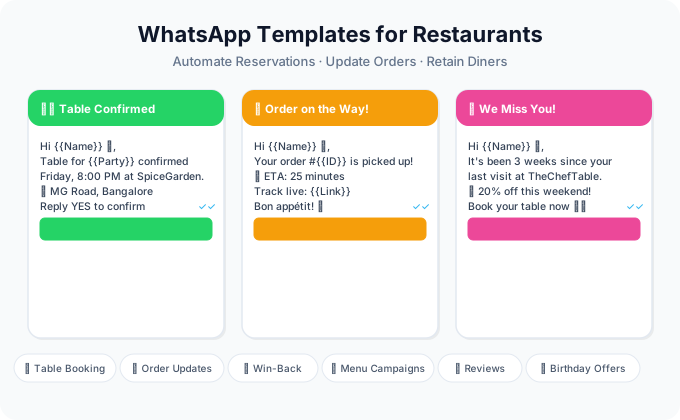
Table reservation management is one of the most time-consuming tasks for restaurant front-of-house staff — especially during peak booking hours when phones and WhatsApp messages compete with in-restaurant guests for attention. Every manual booking confirmation is a moment a staff member is not serving the table in front of them. BetaXLab's reservation automation changes this completely. When a customer messages to book a table, an AI chatbot collects all required information — date, time, party size, seating preference, dietary requirements, and occasion — checks availability in real time, and sends an instant confirmation without any human involvement.
The no-show problem costs restaurants significant revenue every week. BetaXLab's automated reminder sequence sends a confirmation the day before and a final reminder two hours before the reservation, with one-tap options to confirm, reschedule, or cancel. Restaurants using this system consistently see no-show rates drop by 35-40%, and released tables can be immediately offered to waitlisted customers — turning a potential revenue loss into a fully booked dining room.
Customer Retention Automation: Building a Loyal Dining Community
Acquiring a new restaurant customer costs significantly more than retaining an existing one — yet most restaurants invest heavily in new customer acquisition through aggregator platforms while having no system to bring diners back. BetaXLab's retention automation changes this equation permanently. Win-back campaigns fire automatically when a diner hasn't visited in 21 days, birthday and anniversary offers are sent based on customer data collected at booking, and loyalty rewards are communicated directly on WhatsApp with a message open rate that consistently exceeds 90%.
The compounding effect of retention automation is significant. Each campaign costs a fraction of paid acquisition — and as your opted-in customer list grows, the revenue potential of each broadcast increases proportionally. Restaurants that run systematic WhatsApp retention programmes report repeat visit rates that are 40-60% higher than businesses relying solely on aggregator platforms for customer re-engagement.
Menu Campaign Broadcasts That Fill Tables on Quiet Nights
The quiet Tuesday evening or the slow Monday lunch service are exactly the situations that WhatsApp broadcast campaigns are designed to solve. A targeted offer to your opted-in diner list — a weekday lunch combo, a happy hour promotion, or a last-minute weekend special — reaches customers with 90%+ open rates and drives measurable footfall within hours of sending. Contrast this with email campaigns that typically achieve 15-20% open rates and require customers to be actively checking their inbox at the right moment.
BetaXLab's broadcast tool supports rich media messages with food photography, video content, and interactive buttons — giving your restaurant the same visual quality as Instagram promotions with the directness and immediacy of a personal message. New menu launches, festive dining packages, and seasonal specials all perform dramatically better on WhatsApp than any other channel your restaurant can use today.
Managing Delivery Orders and Customer Queries at Scale
Cloud kitchens and restaurants with active delivery operations face a specific challenge: the volume of "where is my order?" messages during peak delivery hours can overwhelm any team. Without proactive order status updates, every delivery generates multiple inbound messages — each requiring a staff member to check the POS, check the delivery status, and type a response. BetaXLab eliminates this entirely by integrating with your POS and delivery management system to trigger automatic WhatsApp notifications at every order milestone.
Customers receive a confirmation when their order is placed, a notification when preparation begins, an out-for-delivery message with ETA and tracking link, and a delivery confirmation once the order arrives. The result is a dramatic reduction in inbound support messages — often 60% or more — allowing your team to focus on in-restaurant operations while delivery customers are kept informed automatically throughout their experience.
Integrating WhatsApp With Your Restaurant POS and Delivery System
The most powerful version of restaurant WhatsApp automation connects your entire operational stack — POS, reservation system, delivery platform, and customer database — to a single WhatsApp communication layer. BetaXLab integrates with leading restaurant POS systems and delivery management platforms to create a unified customer communication system. Every order event, reservation change, and customer interaction is captured, stored, and used to inform future automated messages — creating a progressively smarter automation that gets more effective as your customer data grows.
Multi-outlet restaurant groups benefit particularly from this unified approach. A single WhatsApp Business number can serve all branches, with intelligent routing directing customers to the correct outlet team based on their location or selected branch. Management gets consolidated reporting across all locations — reservation volumes, campaign performance, support response times, and customer retention rates — from a single dashboard. BetaXLab's restaurant platform is built for the operational complexity of growing food businesses, not just single-location cafes.