A WhatsApp AI chatbot can answer common questions, qualify leads and route conversations — but whether a specific tool is right for your business depends on answer accuracy, integrations, human escalation and cost, not on which tool gets mentioned most often online. This guide separates what people researching this topic usually ask from what we can actually verify about available products, including BetaXLab.
On This Page
Before naming any tool, it’s worth naming the questions people bring to this search in the first place. These are common themes we see across public discussion and buyer conversations about WhatsApp AI chatbots — not quotes, usernames or specific threads.
Buyers compare feature pages and demo videos and want to know what holds up once the trial contacts start messaging in real sentences.
A recurring worry is a bot answering fluently but incorrectly — pricing that changed, a policy that no longer applies, or a product that was discontinued.
Many Indian businesses ask whether a chatbot genuinely understands mixed-language, casually-typed messages or only works cleanly in formal English.
Questions about a base subscription versus per-conversation or per-message charges from Meta, and whether a provider's quote includes both.
A common concern is a bot that technically "escalates" but drops context, so the human agent asks the customer to repeat everything.
Buyers ask about exporting contacts, conversation history, and templates if a tool turns out not to fit — before they commit a WhatsApp number to it.
This reflects common patterns we’ve observed across public discussion and buyer conversations about WhatsApp chatbots in general — it is not a citation of specific Reddit threads, users, or quotes, and it is not a claim of “Reddit consensus.”
Regardless of which provider you evaluate, a chatbot worth deploying should do these six things — and you should be able to see each one work in a demo before you buy.
Answer from an approved, business-specific knowledge base rather than inventing information
Handle common FAQs — pricing, policies, hours, availability — without a human
Capture lead details (requirement, budget, timeline) through natural conversation
Route conversations by intent, urgency or topic
Escalate to a human the moment a question falls outside its knowledge base or the customer asks for one
Carry conversation context into the handoff, so the customer never repeats themselves
Picture a small apparel business. A customer messages after hours asking about sizing and whether a kurta can be exchanged for a different size. A knowledge-base-grounded chatbot answers the sizing and exchange-policy questions directly from the business’s uploaded policy document. The same customer then asks whether a specific custom alteration is possible — something the uploaded documents never cover. A well-built bot recognises it has no grounded answer and escalates to a human with the full conversation attached, rather than guessing at a policy that does not exist.
This scenario is illustrative, written to show the handoff point — it is not a real logged conversation or a specific customer interaction.
These three terms get used loosely in vendor marketing. Here is what actually separates them, including the real limitations of each.
| Dimension | Rule-Based Bot | Generative AI Chatbot | RAG-Based AI Chatbot |
|---|---|---|---|
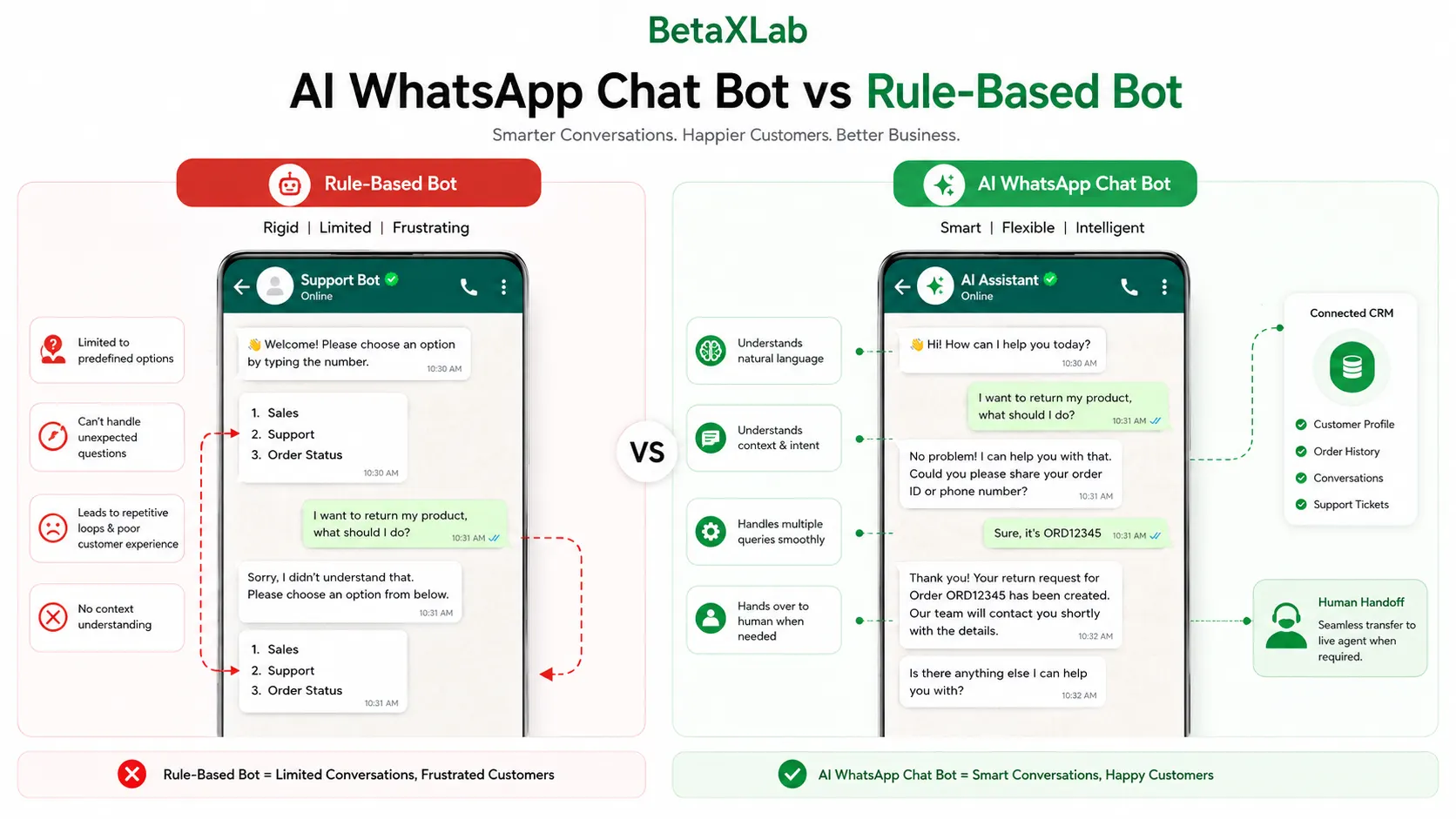
| Natural-Language Understanding | Matches exact keywords or menu taps; breaks on unexpected phrasing | Understands free-form questions and intent, but can generate a plausible-sounding wrong answer if not grounded in real content | Understands free-form questions and grounds replies in retrieved business documents, which generally reduces (but does not eliminate) incorrect answers |
| Main Failure Mode | Fails silently when phrasing does not match a script | Can hallucinate confident, incorrect detail with no source behind it | Can still answer incorrectly if the retrieved document is outdated, conflicting, or the wrong passage is matched |
| Upkeep Required | Every new flow or phrasing variant has to be built by hand | Needs testing against real questions before launch; knowledge drifts if the model is not grounded to current content | Needs the underlying documents kept current — stale pricing sheets or old policy PDFs are a common source of wrong answers |
| Escalation Trigger | Keyword match for "agent" or similar, or falling off the script entirely | Out-of-scope topics, low confidence, or explicit request for a human | Same as AI, plus cases where retrieval finds no relevant passage at all |
| Where It Fits | Small, predictable question sets — hours, a fixed menu, order-status lookup | Open-ended conversation where you cannot predict every phrasing in advance | Open-ended conversation where answers must stay grounded in a specific, changing knowledge base (catalogue, policy docs, pricing) |
“RAG” (retrieval-augmented generation) describes grounding a chatbot’s replies in retrieved documents rather than letting it answer purely from general training. Retrieval errors, outdated documents, and genuine model hallucination are real limitations across this category — no vendor, including BetaXLab, eliminates them entirely, which is why human escalation remains necessary.
BetaXLab alongside other WhatsApp platforms people commonly research, compared on knowledge-base support, automation, handoff, analytics, setup effort and price positioning.
| Capability | BetaXLab | WATI | Gallabox | Interakt | AiSensy |
|---|---|---|---|---|---|
| Knowledge-Base / Document Training | Trains on uploaded documents, URLs and structured business content — catalogue, pricing, policies, FAQs | Chatbot builder with FAQ and flow-based training; depth of document ingestion varies by plan | Visual flow builder; knowledge-base style training available on relevant tiers | Chatbot and catalogue-oriented training, geared toward ecommerce content | FAQ and flow-based chatbot setup |
| Lead Qualification | Asks natural-language qualifying questions (budget, requirement, timeline) and writes captured answers to the built-in CRM | Lead capture available; qualification depth depends on flow design | Strong on building qualification flows visually | Lead capture oriented toward order and catalogue context | Lead capture within broadcast and chatbot flows |
| Human Handoff | Escalates on out-of-scope questions, detected frustration, or explicit request, with full conversation context attached | Handoff to shared inbox available; context carried depends on configuration | Handoff supported with team inbox integration | Handoff available, often tied to order-related triggers | Basic handoff to a team inbox |
| Analytics on Bot Performance | Conversation and escalation data feeds the shared inbox and CRM as part of one connected platform | Reporting available; depth varies by plan tier | Flow-level analytics for chatbot builder | Analytics oriented toward commerce metrics | Basic message and campaign reporting |
| Setup Effort | Typically 3–5 business days; longer for multi-language or custom CRM integration work | Setup time varies with flow complexity | Visual builder reduces setup time for simple flows | Setup tied to catalogue and store integration | Generally quick for a basic FAQ bot |
| Price Positioning | Conversation volume, number of languages configured, and whether CRM/shared inbox are bundled drive plan cost — see current plans directly | Tiered plans with features gated to higher tiers | Tiered plans plus usage-based components | Tiered plans with usage components | Credit or tier-based pricing that varies with volume |
Compare official pricing and feature pages directly before deciding — this table reflects general, publicly observable positioning at the time of writing, not live data, and no specific competitor prices are stated because we cannot verify them. See BetaXLab’s own pricing for current plans.
An AI chatbot is not automatically the right answer for every business. Here is a fair way to think about where each approach fits.
A simple rule-based bot is enough
An AI / knowledge-base chatbot earns its cost
Keep a human in the loop regardless
Everything below is a capability BetaXLab currently offers. Where something is uncertain or plan-dependent, we say so rather than guess.
Natural-Language Understanding (GPT-4). Understands free-form questions rather than matching fixed keywords, so customers can ask in their own words.
Custom Knowledge Base Training. Trains on uploaded documents, URLs and structured content — product catalogue, pricing, policies, FAQs — so answers stay grounded in what the business actually offers.
Context Memory. Remembers earlier details in the same conversation, so a customer is not asked to repeat themselves.
9 Languages, Auto-Detected. Hindi, English, Marathi, Tamil, Telugu, Gujarati, Bengali, Kannada and Punjabi, with language auto-detected from the customer's first message.
Lead Qualification. Asks natural-language qualifying questions and captures the answers into the built-in WhatsApp CRM.
Smart Human Escalation. Hands off to the shared team inbox on out-of-scope questions, detected frustration, or an explicit request for a person — with full conversation context attached.
Sample Workflow
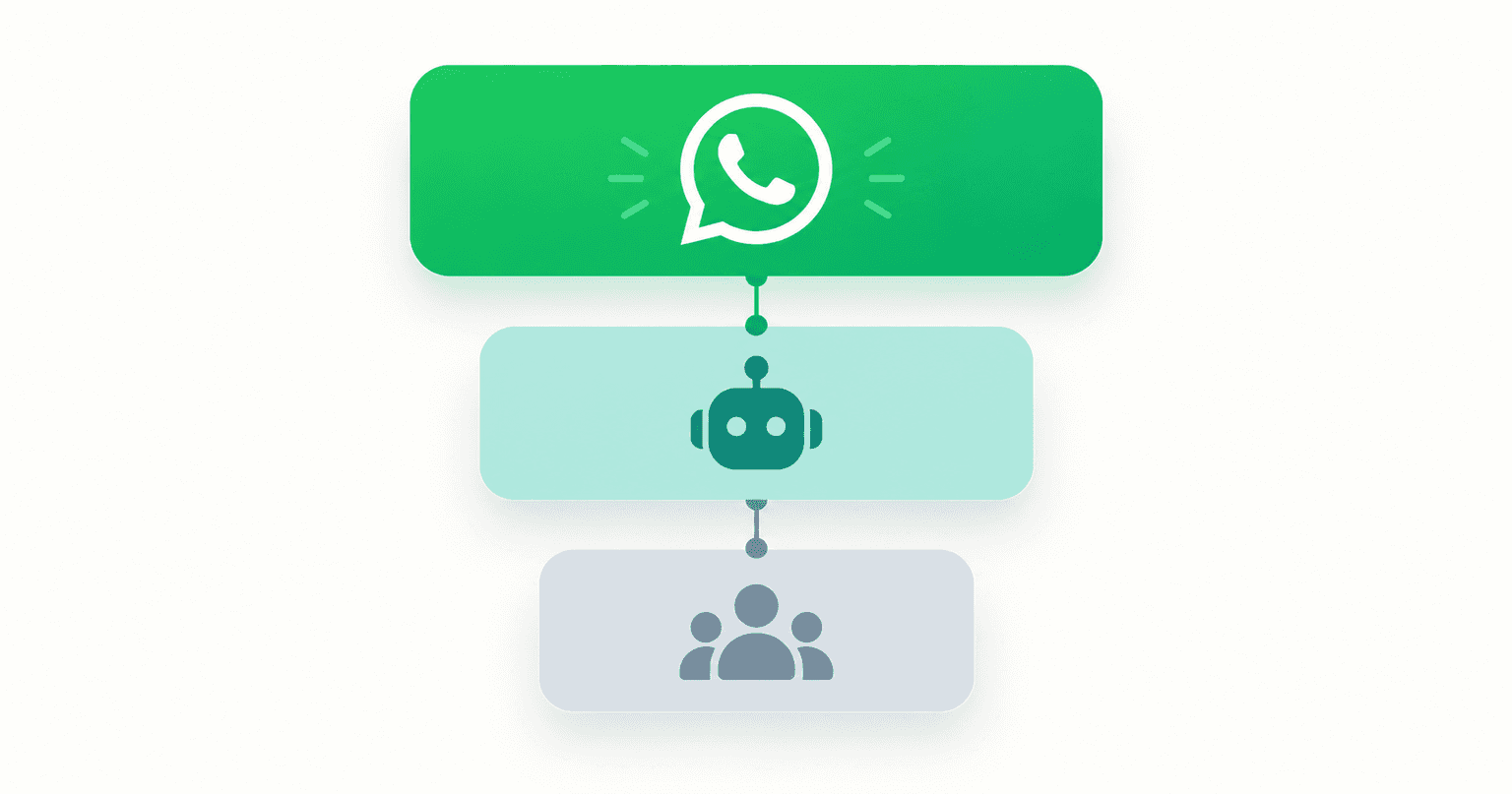
Customer sends an enquiry on WhatsApp → AI reads intent → checks the approved knowledge base → replies in natural language → captures lead or customer details → out-of-scope or complex query routes to a human agent in the shared inbox with full context
Deployment typically takes 3–5 business days — training on your documents, testing against real scenarios, then connecting the Official WhatsApp Business API number. Deployments that add multi-language custom flows or CRM integration work can take up to 7 days.
Plan-level limits — conversation volume included, number of languages configured, and whether the chatbot is bundled with the full CRM and shared inbox — vary by plan and are not fixed numbers we can state here. Check current plans on /pricing or start a free trial to test the chatbot on your own number first.
Request a demo, or read the full WhatsApp AI Chatbot page
Run this checklist against any shortlisted provider — including BetaXLab — before committing a WhatsApp number to it.
| Test Category | What to Do | What to Measure |
|---|---|---|
| Representative questions | Ask the questions your real customers ask most, in their usual phrasing | Answer correctness against your own source documents |
| Unsupported / out-of-scope questions | Ask something genuinely outside the knowledge base | Does it say so and escalate, or guess an answer? |
| Multilingual questions | Test in the languages your customers actually use, including mixed-language messages | Accuracy and tone, not just whether it replies |
| Conflicting-document questions | Deliberately upload two documents with slightly different information | Does it surface the conflict, pick one silently, or escalate? |
| Escalation accuracy | Ask for a human directly, and separately show frustration without asking | Does it hand off cleanly with context, in both cases? |
| Response time & lead capture | Time replies under normal load; check what gets written to your CRM | Response latency and completeness of captured lead data |
Bring your own FAQs, pricing and policy documents and test the questions that matter to your business — including the ones you expect it to fail on.
Last reviewed: October 14, 2026 · Reflects publicly observable product information and BetaXLab’s own documented features at time of writing.
Related Reading
Want to see the chatbot answer your own FAQs?
Try Free →